
AFL之自定義mutator開發分析
前言:
什么是mutator?
通過使用根據給定語法執行突變的庫來啟用結構感知模糊測試,進而達成更細致化模糊數據處理的第三方組件,一般由模糊測試人員自己開發編寫。
在什么環境下需要mutator?
對于xml等固定文件格式的testcase時就需要編寫mutator進行精細化fuzzing。
為什么要用python編寫mutator?
xml型mutator因為python庫更加齊全,所以我們使用python來編寫mutator
我們先來看看afl對mutator的調用流程:
下面是C library版mutator函數afl_custom_fuzz和afl_custom_init和python版fuzz和init本質上是一樣的
afl_custom_fuzz調用分析:
60分鐘仍然一個cycle都沒有找到時,會在env上設置AFL_EXPAND_HAVOC_NOW


然后在分析到env存在AFL_EXPAND_HAVOC_NOW后,將afl->expand_havoc設置為1

當afl->expand_havoc為1時,afl->limit_time_sig = -1
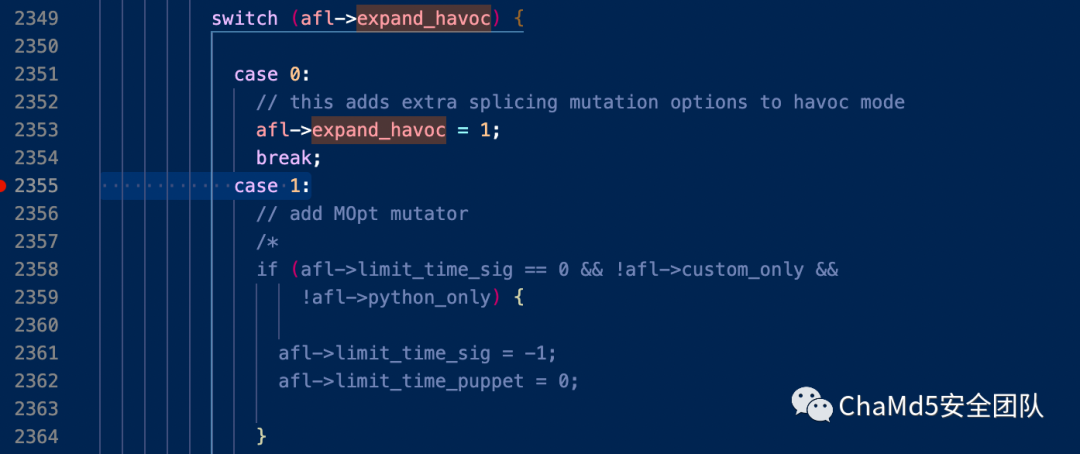
確定afl->limit_time_sig <= 0就執行fuzz_one_original()

然后調用到afl_custom_fuzz

6.png
上面的el->data即為我們-i 指定目錄內部文件的testcase,然后經過自定義mutator來生成自己的testcase
afl_custom_init調用分析:
調用流程:
setup_custom_mutatorsload_custom_mutatorafl_custom_init

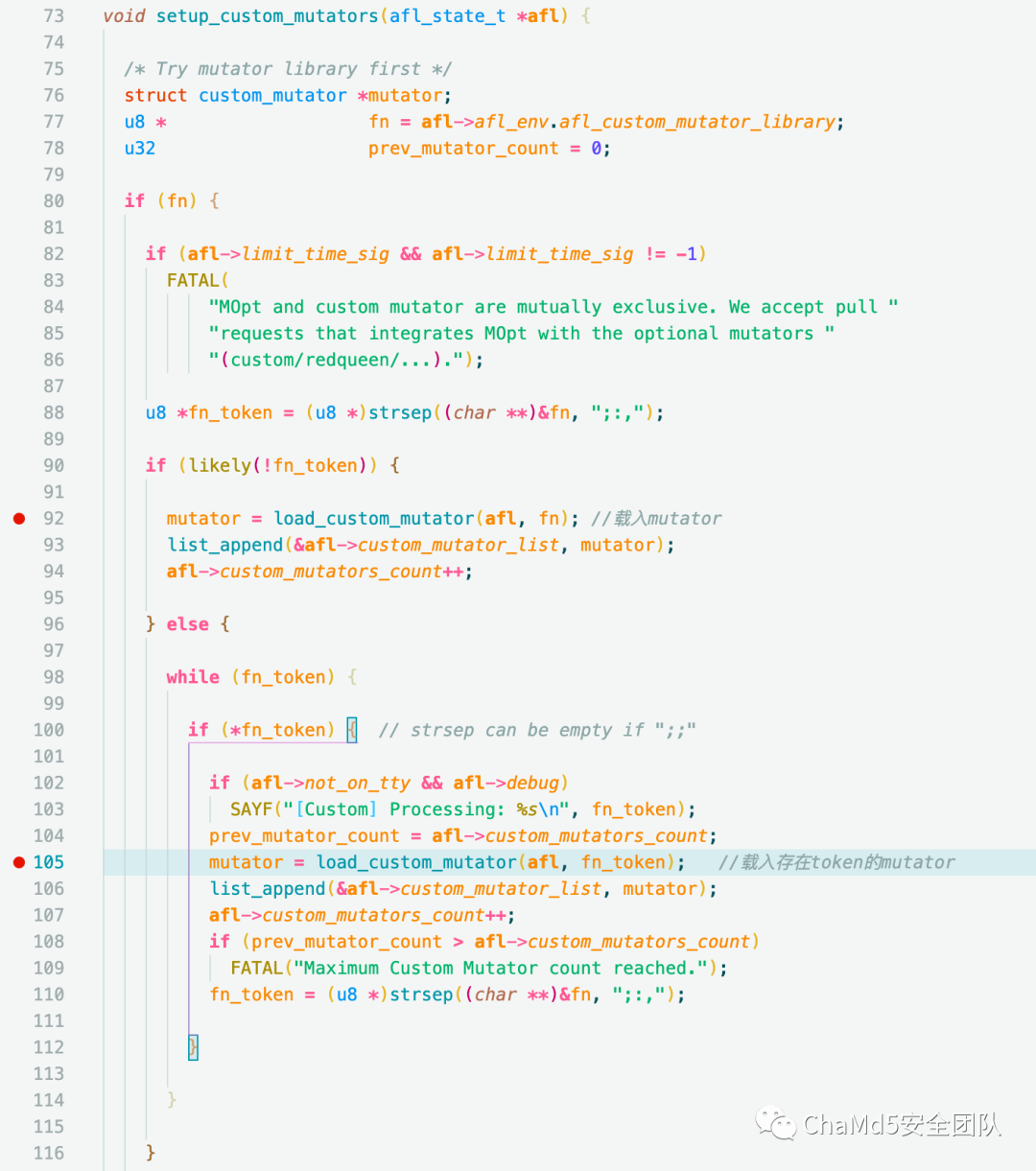

然后給我們的mutator配置包裝好了的afl_t結構體*afl和隨機數種子seed
開發流程:
根據官方開發文檔:Custom Mutators | AFLplusplus 可以知道我們需要定義一個init()來初始化配置我們的seed來保證我們的mutator上的rand隨機性和afl上的rand是同步的。總的來說是調用了lxml來編寫xml型的mutator:
from lxml import etree as ET
配置初始化函數init():
def init(seed):
    """
    Called once when AFL starts up. Seed is used to identify the AFL instance in log files
    """
    global __mutator__      #定義一個類
    global __seed__         #定義一個全局隨機種子
    # Get the seed
    __seed__ = seed         #根據afl傳入的seed重寫我們的seed
    # Create a global mutation class
    try:
        __mutator__ = XmlMutatorMin(__seed__, verbose=__log__) #初始化類
        log("init(): Mutator created")
    except RuntimeError as e:
        log("init(): Can't create mutator: %s" % e.message)
注意這里的__mutator__ = XmlMutatorMin(__seed__, verbose=__log__)就是我們fuzz調用到的函數。然后進入到XmlMutatorMin.py上調用__init__來初始化XmlMutatorMin類:
class XmlMutatorMin:
    """
    Optionals parameters:
        seed        Seed used by the PRNG (default: "RANDOM")
        verbose     Verbosity (default: False)
    """
    def __init__(self, seed="RANDOM", verbose=False):
        """ Initialize seed, database and mutators """
        # Verbosity
        self.verbose = verbose
        # Initialize PRNG
        self.seed = str(seed)
        if self.seed == "RANDOM":
            random.seed()
        else:
            if self.verbose:
                print("Static seed '%s'" % self.seed)
            random.seed(self.seed)
        # Initialize input and output documents
        self.input_tree = None
        self.tree = None
        # High-level mutators (no database needed)
        hl_mutators_delete = [
            "del_node_and_children",
            "del_node_but_children",
            "del_attribute",
            "del_content",
        ]  # Delete items
        hl_mutators_fuzz = ["fuzz_attribute"]  # Randomly change attribute values
        # Exposed mutators
        self.hl_mutators_all = hl_mutators_fuzz + hl_mutators_delete
上面的self.hl_mutators_all就是我們mutator對從afl傳入數據進行模糊處理的函數列表。然后還需要一個deinit()來結束初始化:
def deinit():  # optional for Python
    pass
配置數據模糊函數fuzz():
buf:傳入的數據
def fuzz(buf, add_buf, max_size):
    """
    Called for each fuzzing iteration.
    """
    global __mutator__
    # Do we have a working mutator object?
    if __mutator__ is None:
        log("fuzz(): Can't fuzz, no mutator available")
        return buf
    # Try to use the AFL buffer
    via_buffer = True
    # Interpret the AFL buffer (an array of bytes) as a string
    if via_buffer:
        try:
            buf_str = str(buf)
            log("fuzz(): AFL buffer converted to a string")
        except Exception:
            via_buffer = False
            log("fuzz(): Can't convert AFL buffer to a string")
    # Load XML from the AFL string
    if via_buffer:
        try:
            __mutator__.init_from_string(buf_str)
            log(
                "fuzz(): Mutator successfully initialized with AFL buffer (%d bytes)"
                % len(buf_str)
            )
        except Exception:
            via_buffer = False
            log("fuzz(): Can't initialize mutator with AFL buffer")
    # If init from AFL buffer wasn't succesful
    if not via_buffer:
        log("fuzz(): Returning unmodified AFL buffer")
        return buf
    # Sucessful initialization -> mutate
    try:
        __mutator__.mutate(max=5)
        log("fuzz(): Input mutated")
    except Exception:
        log("fuzz(): Can't mutate input => returning buf")
        return buf
    # Convert mutated data to a array of bytes
    try:
        data = bytearray(__mutator__.save_to_string())
        log("fuzz(): Mutated data converted as bytes")
    except Exception:
        log("fuzz(): Can't convert mutated data to bytes => returning buf")
        return buf
    # Everything went fine, returning mutated content
    log("fuzz(): Returning %d bytes" % len(data))
    return data
上述代碼對從afl傳入的buf進行了4步處理:
一、格式化輸出afl傳入的buf:
buf_str = str(buf)
二、將xml流構造成樹:
__mutator__.init_from_string(buf_str)
三、對已經被構造成樹的數據流數據進行模糊操作:
max表示了對數據處理的最大次數
__mutator__.mutate(max=5)
四、將模糊處理后的xml樹數據保存成testcase:
data = bytearray(__mutator__.save_to_string())
init_from_string:
對傳入的xml流重構成tree,進而更好的對數據進行處理
def init_from_string(self, input_string):
    """ Initialize the mutator from a XML string """
    # Get a pointer to the top-element
    self.input_tree = self.__parse_xml(input_string)
    # Get a working copy
    self.tree = deepcopy(self.input_tree)  # 使用deepcopy生成一個用于處理數據的臨時樹
def __parse_xml(self, xml):
    """ Parse an XML string. Basic wrapper around lxml.parse() """
    try:
        tree = ET.parse(io.BytesIO(xml))  # 使用了lxml.etree.parse對傳入的xml流重構成樹
    except ET.ParseError:
        raise RuntimeError("XML isn't well-formed!")
    except LookupError as e:
        raise RuntimeError(e)
    # Return a document wrapper
    return tree
mutate:
對xml數據進行模糊處理類型可以分為:
- 刪除結點但是保存子結點
- 刪除結點但是不保存子結點
- 刪除屬性
- 刪除內容
- 對屬性數據進行模糊處理
一、保證模糊處理函數調用的隨機性:
def mutate(self, min=1, max=5):
    """ Execute some high-level mutators between $min and $max times, then some medium-level ones """
    # High-level mutation
    self.__exec_among(self, self.hl_mutators_all, min, max)
def __exec_among(self, module, functions, min_times, max_times):
    """ Randomly execute $functions between $min and $max times """
    for i in xrange(random.randint(min_times, max_times)):
        # Function names are mangled because they are "private"
        getattr(module, "_XmlMutatorMin__" + random.choice(functions))()
min和max保證了調用數據模糊處理的次數隨機性(即調用多少次對數據的處理操作) __exec_among保證了對數據模糊處理的類型隨機性(即隨機選擇上面的模糊處理類型操作)
二、刪除結點:
def __del_node(self, delete_children):
    """ Called by the __del_node_* mutators """
    # Select a node to modify (but the root one)
    (rand_elem_id, rand_elem) = self.__pick_element(exclude_root_node=True)
    # If the document includes only a top-level element
    # Then we can't pick a element (given that "exclude_root_node = True")
    # Is the document deep enough?
    if rand_elem is None:
        if self.verbose:
            print("Can't delete a node: document not deep enough!")
        return
    # Log something
    if self.verbose:
        but_or_and = "and" if delete_children else "but"
        print(
            "Deleting tag #%i '%s' %s its children"
            % (rand_elem_id, rand_elem.tag, but_or_and)
        )
    if delete_children is False:
        # Link children of the random (soon to be deleted) node to its parent
        for child in rand_elem:
            rand_elem.getparent().append(child)
    # Remove the node
    rand_elem.getparent().remove(rand_elem)
調用了lxml.etree.getparent()獲取到當前結點的父結點,進而刪除node 如果delete_children為true則調用lxml.etree.append()將子node附加到父node的上一個node 如果delete_children為false則調用lxml.etree.remove()將整個父node刪除
保存子結點:
def __del_node_and_children(self):
    """High-level minimizing mutator
    Delete a random node and its children (i.e. delete a random tree)"""
    self.__del_node(True)
不保存子結點:
def __del_node_but_children(self):
    """High-level minimizing mutator
    Delete a random node but its children (i.e. link them to the parent of the deleted node)"""
    self.__del_node(False)
三、刪除屬性:
def __del_attribute(self):
    """High-level minimizing mutator
    Delete a random attribute from a random node"""
    # Select a node to modify
    (rand_elem_id, rand_elem) = self.__pick_element()
    # Get all the attributes
    attribs = rand_elem.keys()
    # Is there attributes?
    if len(attribs) < 1:
        if self.verbose:
            print("No attribute: can't delete!")
        return
    # Pick a random attribute
    rand_attrib_id = random.randint(0, len(attribs) - 1)
    rand_attrib = attribs[rand_attrib_id]
    # Log something
    if self.verbose:
        print(
            "Deleting attribute #%i '%s' of tag #%i '%s'"
            % (rand_attrib_id, rand_attrib, rand_elem_id, rand_elem.tag)
        )
    # Delete the attribute
    rand_elem.attrib.pop(rand_attrib)
使用lxml.etree.attrib.pop()刪除node里面的某一屬性四、刪除內容:
def __del_content(self):
    """High-level minimizing mutator
    Delete the attributes and children of a random node"""
    # Select a node to modify
    (rand_elem_id, rand_elem) = self.__pick_element()
    # Log something
    if self.verbose:
        print("Reseting tag #%i '%s'" % (rand_elem_id, rand_elem.tag))
    # Reset the node
    rand_elem.clear()
使用lxml.etree.clear()刪除node內的content五、對屬性數據進行模糊處理:
    def __fuzz_attribute(self):
        """ Fuzz (part of) an attribute value """
        # Select a node to modify
        (rand_elem_id, rand_elem) = self.__pick_element()
        # Get all the attributes
        attribs = rand_elem.keys()
        # Is there attributes?
        if len(attribs) < 1:
            if self.verbose:
                print("No attribute: can't replace!")
            return
        # Pick a random attribute
        rand_attrib_id = random.randint(0, len(attribs) - 1)    # 隨機獲取屬性id
        rand_attrib = attribs[rand_attrib_id]                   # 獲取知道屬性id指向的屬性
        # We have the attribute to modify
        # Get its value
        attrib_value = rand_elem.get(rand_attrib)               # 獲取指定屬性的數據
        # print("- Value: " + attrib_value)
        # Should we work on the whole value?
        func_call = "(?P[a-zA-Z:\-]+)\((?P.*?)\)"
        p = re.compile(func_call)
        l = p.findall(attrib_value)
        if random.choice((True, False)) and l:
            # Randomly pick one the function calls
            (func, args) = random.choice(l)
            # Split by "," and randomly pick one of the arguments
            value = random.choice(args.split(","))
            # Remove superfluous characters
            unclean_value = value
            value = value.strip(" ").strip("'")
            # print("Selected argument: [%s]" % value)
        else:
            value = attrib_value
        # For each type, define some possible replacement values
        choices_number = (
            "0",
            "11111",
            "-128",
            "2",
            "-1",
            "1/3",
            "42/0",
            "1094861636 idiv 1.0",
            "-1123329771506872 idiv 3.8",
            "17=$numericRTF",
            str(3 + random.randrange(0, 100)),
        )
        choices_letter = (
            "P" * (25 * random.randrange(1, 100)),
            "%s%s%s%s%s%s",
            "foobar",
        )
        choices_alnum = (
            "Abc123",
            "020F0302020204030204",
            "020F0302020204030204" * (random.randrange(5, 20)),
        )
        # Fuzz the value
        if random.choice((True, False)) and value == "":
            # 為NULL不管
            new_value = value
        elif random.choice((True, False)) and value.isdigit():
            # number用number替代
            new_value = random.choice(choices_number)
        elif random.choice((True, False)) and value.isalpha():
            # 文本用文本替代
            new_value = random.choice(choices_letter)
        elif random.choice((True, False)) and value.isalnum():
            # 字母數字就用字母數字替代
            new_value = random.choice(choices_alnum)
        else:
            # Default type
            new_value = random.choice(choices_alnum + choices_letter + choices_number)
        # If we worked on a substring, apply changes to the whole string
        if value != attrib_value:
            # No ' around empty values
            if new_value != "" and value != "":
                new_value = "'" + new_value + "'"
            # Apply changes
            new_value = attrib_value.replace(unclean_value, new_value)
        # Log something
        if self.verbose:
            print(
                "Fuzzing attribute #%i '%s' of tag #%i '%s'"
                % (rand_attrib_id, rand_attrib, rand_elem_id, rand_elem.tag)
            )
        # Modify the attribute
        rand_elem.set(rand_attrib, new_value.decode("utf-8"))
實質就是隨機正則某個屬性數據,然后使用自制字典同類型替換
真正使用的mutator要自開發python3兼容的版本,然后還要bytearrary()包含格式化輸出才能正常使用。
AFL++ 調用Python Library:
export PYTHONPATH=/home/mutator/
export AFL_PYTHON_MODULE=mutator
afl-fuzz ....
PYTHONPATH:指向mutator.py的路徑
export AFL_PYTHON_MODULE:指定文件夾內mutator.py,注意不能有.py后綴
afl-fuzz ....:為afl-fuzz的執行命令
