waf指紋識別工具WAFW00F的原理,安裝與使用
原理
發送正常的 HTTP 請求并分析響應;這確定了許多 WAF 解決方案。
如果不成功,則發送多個(可能是惡意的)HTTP 請求,并使用簡單的邏輯來
示例就是WAF。,則分析先前回復的響應,并采用另一種簡單的方法來搶救WAF或安全解決是否正在積極響應我們的請求。
事實上它的核心就是其中的main.py:
#!/usr/bin/env python
# -*- coding: utf-8 -*-
'''
Copyright (C) 2019, WAFW00F Developers.
See the LICENSE file for copying permission.
'''
import csv
import io
import json
import logging
import os
import random
import re
import sys
from collections import defaultdict
from optparse import OptionParser
from wafw00f.lib.asciiarts import *
from wafw00f import __version__, __license__
from wafw00f.manager import load_plugins
from wafw00f.wafprio import wafdetectionsprio
from wafw00f.lib.evillib import urlParser, waftoolsengine, def_headers

class WAFW00F(waftoolsengine):

    xsstring = 'alert("XSS");'
    sqlistring = "UNION SELECT ALL FROM information_schema AND ' or SLEEP(5) or '"
    lfistring = '../../../../etc/passwd'
    rcestring = '/bin/cat /etc/passwd; ping 127.0.0.1; curl google.com'
    xxestring = ']>&hack;'

    def __init__(self, target='www.example.com', debuglevel=0, path='/',
                 followredirect=True, extraheaders={}, proxies=None):

        self.log = logging.getLogger('wafw00f')
        self.attackres = None
        waftoolsengine.__init__(self, target, debuglevel, path, proxies, followredirect, extraheaders)
        self.knowledge = dict(generic=dict(found=False, reason=''), wafname=list())

    def normalRequest(self):
        return self.Request()

    def customRequest(self, headers=None):
        return self.Request(headers=headers)

    def nonExistent(self):
        return self.Request(path=self.path + str(random.randrange(100, 999)) + '.html')

    def xssAttack(self):
        return self.Request(path=self.path, params= {'s': self.xsstring})

    def xxeAttack(self):
        return self.Request(path=self.path, params= {'s': self.xxestring})

    def lfiAttack(self):
        return self.Request(path=self.path + self.lfistring)

    def centralAttack(self):
        return self.Request(path=self.path, params={'a': self.xsstring, 'b': self.sqlistring, 'c': self.lfistring})

    def sqliAttack(self):
        return self.Request(path=self.path, params= {'s': self.sqlistring})

    def oscAttack(self):
        return self.Request(path=self.path, params= {'s': self.rcestring})

    def performCheck(self, request_method):
        r = request_method()
        if r is None:
            raise RequestBlocked()
        return r

    # Most common attacks used to detect WAFs
    attcom = [xssAttack, sqliAttack, lfiAttack]
    attacks = [xssAttack, xxeAttack, lfiAttack, sqliAttack, oscAttack]

    def genericdetect(self):
        reason = ''
        reasons = ['Blocking is being done at connection/packet level.',
                   'The server header is different when an attack is detected.',
                   'The server returns a different response code when an attack string is used.',
                   'It closed the connection for a normal request.',
                   'The response was different when the request wasn\'t made from a browser.'
                ]
        try:
            # Testing for no user-agent response. Detects almost all WAFs out there.
            resp1 = self.performCheck(self.normalRequest)
            if 'User-Agent' in self.headers:
                del self.headers['User-Agent']  # Deleting the user-agent key from object not dict.
            resp3 = self.customRequest(headers=def_headers)
            if resp1.status_code != resp3.status_code:
                self.log.info('Server returned a different response when request didn\'t contain the User-Agent header.')
                reason = reasons[4]
                reason += '\r'
                reason += 'Normal response code is "%s",' % resp1.status_code
                reason += ' while the response code to a modified request is "%s"' % resp3.status_code
                self.knowledge['generic']['reason'] = reason
                self.knowledge['generic']['found'] = True
                return True

            # Testing the status code upon sending a xss attack
            resp2 = self.performCheck(self.xssAttack)
            if resp1.status_code != resp2.status_code:
                self.log.info('Server returned a different response when a XSS attack vector was tried.')
                reason = reasons[2]
                reason += '\r'
                reason += 'Normal response code is "%s",' % resp1.status_code
                reason += ' while the response code to cross-site scripting attack is "%s"' % resp2.status_code
                self.knowledge['generic']['reason'] = reason
                self.knowledge['generic']['found'] = True
                return True

            # Testing the status code upon sending a lfi attack
            resp2 = self.performCheck(self.lfiAttack)
            if resp1.status_code != resp2.status_code:
                self.log.info('Server returned a different response when a directory traversal was attempted.')
                reason = reasons[2]
                reason += '\r'
                reason += 'Normal response code is "%s",' % resp1.status_code
                reason += ' while the response code to a file inclusion attack is "%s"' % resp2.status_code
                self.knowledge['generic']['reason'] = reason
                self.knowledge['generic']['found'] = True
                return True

            # Testing the status code upon sending a sqli attack
            resp2 = self.performCheck(self.sqliAttack)
            if resp1.status_code != resp2.status_code:
                self.log.info('Server returned a different response when a SQLi was attempted.')
                reason = reasons[2]
                reason += '\r'
                reason += 'Normal response code is "%s",' % resp1.status_code
                reason += ' while the response code to a SQL injection attack is "%s"' % resp2.status_code
                self.knowledge['generic']['reason'] = reason
                self.knowledge['generic']['found'] = True
                return True

            # Checking for the Server header after sending malicious requests
            response = self.attackres
            normalserver = resp1.headers.get('Server')
            attackresponse_server = response.headers.get('Server')
            if attackresponse_server:
                if attackresponse_server != normalserver:
                    self.log.info('Server header changed, WAF possibly detected')
                    self.log.debug('Attack response: %s' % attackresponse_server)
                    self.log.debug('Normal response: %s' % normalserver)
                    reason = reasons[1]
                    reason += '\rThe server header for a normal response is "%s",' % normalserver
                    reason += ' while the server header a response to an attack is "%s",' % attackresponse_server
                    self.knowledge['generic']['reason'] = reason
                    self.knowledge['generic']['found'] = True
                    return True

        # If at all request doesn't go, press F
        except RequestBlocked:
            self.knowledge['generic']['reason'] = reasons[0]
            self.knowledge['generic']['found'] = True
            return True
        return False

    def matchHeader(self, headermatch, attack=False):
        if attack:
            r = self.attackres
        else: r = rq
        if r is None:
            return
        header, match = headermatch
        headerval = r.headers.get(header)
        if headerval:
            # set-cookie can have multiple headers, python gives it to us
            # concatinated with a comma
            if header == 'Set-Cookie':
                headervals = headerval.split(', ')
            else:
                headervals = [headerval]
            for headerval in headervals:
                if re.search(match, headerval, re.I):
                    return True
        return False

    def matchStatus(self, statuscode, attack=True):
        if attack:
            r = self.attackres
        else: r = rq
        if r is None:
            return
        if r.status_code == statuscode:
            return True
        return False

    def matchCookie(self, match, attack=False):
        return self.matchHeader(('Set-Cookie', match), attack=attack)

    def matchReason(self, reasoncode, attack=True):
        if attack:
            r = self.attackres
        else: r = rq
        if r is None:
            return
        # We may need to match multiline context in response body
        if str(r.reason) == reasoncode:
            return True
        return False

    def matchContent(self, regex, attack=True):
        if attack:
            r = self.attackres
        else: r = rq
        if r is None:
            return
        # We may need to match multiline context in response body
        if re.search(regex, r.text, re.I):
            return True
        return False

    wafdetections = dict()

    plugin_dict = load_plugins()
    result_dict = {}
    for plugin_module in plugin_dict.values():
        wafdetections[plugin_module.NAME] = plugin_module.is_waf
    # Check for prioritized ones first, then check those added externally
    checklist = wafdetectionsprio
    checklist += list(set(wafdetections.keys()) - set(checklist))

    def identwaf(self, findall=False):
        detected = list()
        try:
            self.attackres = self.performCheck(self.centralAttack)
        except RequestBlocked:
            return detected
        for wafvendor in self.checklist:
            self.log.info('Checking for %s' % wafvendor)
            if self.wafdetections[wafvendor](self):
                detected.append(wafvendor)
                if not findall:
                    break
        self.knowledge['wafname'] = detected
        return detected

def calclogginglevel(verbosity):
    default = 40  # errors are printed out
    level = default - (verbosity * 10)
    if level < 0:
        level = 0
    return level

def buildResultRecord(url, waf):
    result = {}
    result['url'] = url
    if waf:
        result['detected'] = True
        if waf == 'generic':
            result['firewall'] = 'Generic'
            result['manufacturer'] = 'Unknown'
        else:
            result['firewall'] = waf.split('(')[0].strip()
            result['manufacturer'] = waf.split('(')[1].replace(')', '').strip()
    else:
        result['detected'] = False
        result['firewall'] = 'None'
        result['manufacturer'] = 'None'
    return result

def getTextResults(res=None):
    # leaving out some space for future possibilities of newer columns
    # newer columns can be added to this tuple below
    keys = ('detected')
    res = [({key: ba[key] for key in ba if key not in keys}) for ba in res]
    rows = []
    for dk in res:
        p = [str(x) for _, x in dk.items()]
        rows.append(p)
    for m in rows:
        m[1] = f'{m[1]} ({m[2]})'
        m.pop()
    defgen = [
        (max([len(str(row)) for row in rows]) + 3)
        for i in range(len(rows[0]))
    ]
    rwfmt = "".join(["{:>"+str(dank)+"}" for dank in defgen])
    textresults = []
    for row in rows:
        textresults.append(rwfmt.format(*row))
    return textresults

def disableStdOut():
    sys.stdout = None

def enableStdOut():
    sys.stdout = sys.__stdout__

def getheaders(fn):
    headers = {}
    if not os.path.exists(fn):
        logging.getLogger('wafw00f').critical('Headers file "%s" does not exist!' % fn)
        return
    with io.open(fn, 'r', encoding='utf-8') as f:
        for line in f.readlines():
            _t = line.split(':', 2)
            if len(_t) == 2:
                h, v = map(lambda x: x.strip(), _t)
                headers[h] = v
    return headers

class RequestBlocked(Exception):
    pass

def main():
    parser = OptionParser(usage='%prog url1 [url2 [url3 ... ]]\rexample: %prog http://www.victim.org/')
    parser.add_option('-v', '--verbose', action='count', dest='verbose', default=0,
                      help='Enable verbosity, multiple -v options increase verbosity')
    parser.add_option('-a', '--findall', action='store_true', dest='findall', default=False,
                      help='Find all WAFs which match the signatures, do not stop testing on the first one')
    parser.add_option('-r', '--noredirect', action='store_false', dest='followredirect',
                      default=True, help='Do not follow redirections given by 3xx responses')
    parser.add_option('-t', '--test', dest='test', help='Test for one specific WAF')
    parser.add_option('-o', '--output', dest='output', help='Write output to csv, json or text file depending on file extension. For stdout, specify - as filename.',
                      default=None)
    parser.add_option('-i', '--input-file', dest='input', help='Read targets from a file. Input format can be csv, json or text. For csv and json, a `url` column name or element is required.',
                      default=None)
    parser.add_option('-l', '--list', dest='list', action='store_true',
                      default=False, help='List all WAFs that WAFW00F is able to detect')
    parser.add_option('-p', '--proxy', dest='proxy', default=None,
                      help='Use an HTTP proxy to perform requests, examples: http://hostname:8080, socks5://hostname:1080, http://user:pass@hostname:8080')
    parser.add_option('--version', '-V', dest='version', action='store_true',
                      default=False, help='Print out the current version of WafW00f and exit.')
    parser.add_option('--headers', '-H', dest='headers', action='store', default=None,
                      help='Pass custom headers via a text file to overwrite the default header set.')
    options, args = parser.parse_args()
    logging.basicConfig(level=calclogginglevel(options.verbose))
    log = logging.getLogger('wafw00f')
    if options.output == '-':
        disableStdOut()
    print(randomArt())
    if options.list:
        print('[+] Can test for these WAFs:\r')
        attacker = WAFW00F(None)
        try:
            m = [i.replace(')', '').split(' (') for i in wafdetectionsprio]
            print(R+'  WAF Name'+' '*24+'Manufacturer  '+'-'*8+' '*24+'-'*12+'')
            max_len = max(len(str(x)) for k in m for x in k)
            for inner in m:
                first = True
                for elem in inner:
                    if first:
                        text = Y+"  {:<{}} ".format(elem, max_len+2)
                        first = False
                    else:
                        text = W+"{:<{}} ".format(elem, max_len+2)
                    print(text, E, end="")
                print()
            sys.exit(0)
        except Exception:
            return
    if options.version:
        print('[+] The version of WAFW00F you have is %sv%s%s' % (B, __version__, E))
        print('[+] WAFW00F is provided under the %s%s%s license.' % (C, __license__, E))
        return
    extraheaders = {}
    if options.headers:
        log.info('Getting extra headers from %s' % options.headers)
        extraheaders = getheaders(options.headers)
        if extraheaders is None:
            parser.error('Please provide a headers file with colon delimited header names and values')
    if len(args) == 0 and not options.input:
        parser.error('No test target specified.')
    #check if input file is present
    if options.input:
        log.debug("Loading file '%s'" % options.input)
        try:
            if options.input.endswith('.json'):
                with open(options.input) as f:
                    try:
                        urls = json.loads(f.read())
                    except json.decoder.JSONDecodeError:
                        log.critical("JSON file %s did not contain well-formed JSON", options.input)
                        sys.exit(1)
                log.info("Found: %s urls to check." %(len(urls)))
                targets = [ item['url'] for item in urls ]
            elif options.input.endswith('.csv'):
                columns = defaultdict(list)
                with open(options.input) as f:
                    reader = csv.DictReader(f)
                    for row in reader:
                        for (k,v) in row.items():
                            columns[k].append(v)
                targets = columns['url']
            else:
                with open(options.input) as f:
                    targets = [x for x in f.read().splitlines()]
        except FileNotFoundError:
            log.error('File %s could not be read. No targets loaded.', options.input)
            sys.exit(1)
    else:
        targets = args
    results = []
    for target in targets:
        if not target.startswith('http'):
            log.info('The url %s should start with http:// or https:// .. fixing (might make this unusable)' % target)
            target = 'https://' + target
        print('[*] Checking %s' % target)
        pret = urlParser(target)
        if pret is None:
            log.critical('The url %s is not well formed' % target)
            sys.exit(1)
        (hostname, port, path, _, _) = pret
        log.info('starting wafw00f on %s' % target)
        proxies = dict()
        if options.proxy:
            proxies = {
                "http": options.proxy,
                "https": options.proxy,
            }
        attacker = WAFW00F(target, debuglevel=options.verbose, path=path,
                    followredirect=options.followredirect, extraheaders=extraheaders,
                        proxies=proxies)
        global rq
        rq = attacker.normalRequest()
        if rq is None:
            log.error('Site %s appears to be down' % hostname)
            continue
        if options.test:
            if options.test in attacker.wafdetections:
                waf = attacker.wafdetections[options.test](attacker)
                if waf:
                    print('[+] The site %s%s%s is behind %s%s%s WAF.' % (B, target, E, C, options.test, E))
                else:
                    print('[-] WAF %s was not detected on %s' % (options.test, target))
            else:
                print('[-] WAF %s was not found in our list\rUse the --list option to see what is available' % options.test)
            return
        waf = attacker.identwaf(options.findall)
        log.info('Identified WAF: %s' % waf)
        if len(waf) > 0:
            for i in waf:
                results.append(buildResultRecord(target, i))
            print('[+] The site %s%s%s is behind %s%s%s WAF.' % (B, target, E, C, (E+' and/or '+C).join(waf), E))
        if (options.findall) or len(waf) == 0:
            print('[+] Generic Detection results:')
            if attacker.genericdetect():
                log.info('Generic Detection: %s' % attacker.knowledge['generic']['reason'])
                print('[*] The site %s seems to be behind a WAF or some sort of security solution' % target)
                print('[~] Reason: %s' % attacker.knowledge['generic']['reason'])
                results.append(buildResultRecord(target, 'generic'))
            else:
                print('[-] No WAF detected by the generic detection')
                results.append(buildResultRecord(target, None))
        print('[~] Number of requests: %s' % attacker.requestnumber)
    #print table of results
    if len(results) > 0:
        log.info("Found: %s matches." % (len(results)))
    if options.output:
        if options.output == '-':
            enableStdOut()
            print(os.linesep.join(getTextResults(results)))
        elif options.output.endswith('.json'):
            log.debug("Exporting data in json format to file: %s" % (options.output))
            with open(options.output, 'w') as outfile:
                json.dump(results, outfile, indent=2)
        elif options.output.endswith('.csv'):
            log.debug("Exporting data in csv format to file: %s" % (options.output))
            with open(options.output, 'w') as outfile:
                csvwriter = csv.writer(outfile, delimiter=',', quotechar='"',
                    quoting=csv.QUOTE_MINIMAL)
                count = 0
                for result in results:
                    if count == 0:
                        header = result.keys()
                        csvwriter.writerow(header)
                        count += 1
                    csvwriter.writerow(result.values())
        else:
            log.debug("Exporting data in text format to file: %s" % (options.output))
            with open(options.output, 'w') as outfile:
                outfile.write(os.linesep.join(getTextResults(results)))

if __name__ == '__main__':
    if sys.hexversion < 0x2060000:
        sys.stderr.write('Your version of python is way too old... please update to 2.6 or later\r')
    main()
安裝
github地址:https://github.com/EnableSecurity/wafw00f
官方使用文檔:https://github.com/enablesecurity/wafw00f/wiki
安裝環境:python3環境 --->使用pip install wafw00f進行安裝
安裝成功后目錄:python安裝目錄中的Lib\site-packages\wafw00f--->例如:C:\Python37\Lib\site-packages\wafw00f
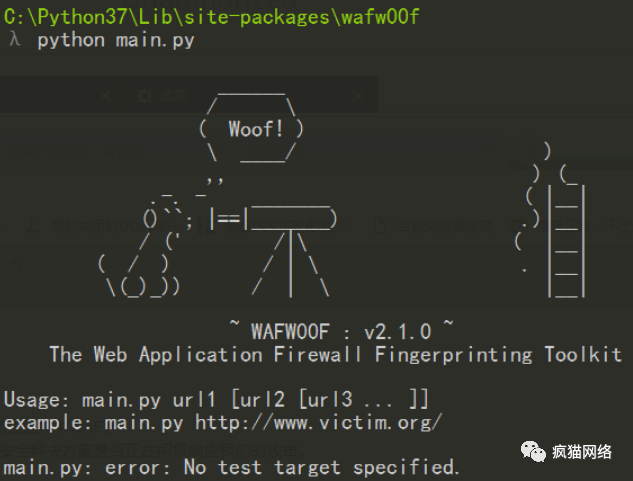
驗證:cd到C:\Python37\Lib\site-packages\wafw00f目錄中,輸入python main.py如下圖說明安裝成功。
具體使用
這里我們直接使用kali,kali中自帶自帶WAFW00F:
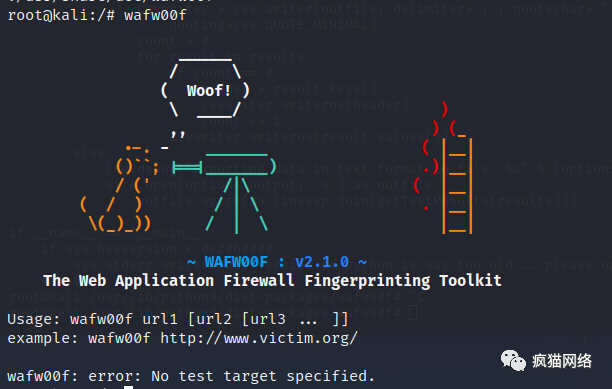
輸入wafw00f --help或者wafw00f -h,可以看到很多使用參數:
  -h, --help            show this help message and exit

  -v, --verbose         Enable verbosity, multiple -v options increase
                        verbosity

  -a, --findall         Find all WAFs which match the signatures, do notstop
                        testing on the first one

  -r, --noredirect      Do not follow redirections given by 3xx responses

  -t TEST, --test=TEST  Test for one specific WAF

  -o OUTPUT, --output=OUTPUT
                        Write output to csv, json or text file depending on
                        file extension. For stdout, specify - as filename.

  -i INPUT, --input-file=INPUT
                        Read targets from a file. Input format can be csv,
                        json or text. For csv and json, a `url` column name or
                        element is required.

  -l, --list            List all WAFs that WAFW00F is able to detect

  -p PROXY, --proxy=PROXY
                        Use an HTTP proxy to perform requests, examples:
                        http://hostname:8080, socks5://hostname:1080,
                        http://user:pass@hostname:8080

  -V, --version         Print out the current version of WafW00f andexit.

  -H HEADERS, --headers=HEADERS
                        Pass custom headers via a text file to overwrite the
                        default header set.
wafw00f -l一次可以識別出的防火墻:
  WAF Name                        Manufacturer
  --------                        ------------

  ACE XML Gateway                  Cisco
  aeSecure                         aeSecure
  AireeCDN                         Airee
  Airlock                          Phion/Ergon
  Alert Logic                      Alert Logic
  AliYunDun                        Alibaba Cloud Computing
  Anquanbao                        Anquanbao
  AnYu                             AnYu Technologies
  Approach                         Approach
  AppWall                          Radware
  Armor Defense                    Armor
  ArvanCloud                       ArvanCloud
  ASP.NET Generic                  Microsoft
  ASPA Firewall                    ASPA Engineering Co.
  Astra                            Czar Securities
  AWS Elastic Load Balancer        Amazon
  AzionCDN                         AzionCDN
  Azure Front Door                 Microsoft
  Barikode                         Ethic Ninja
  Barracuda                        Barracuda Networks
  Bekchy                           Faydata Technologies Inc.
  Beluga CDN                       Beluga
  BIG-IP Local Traffic Manager     F5 Networks
  BinarySec                        BinarySec
  BitNinja                         BitNinja
  BlockDoS                         BlockDoS
  Bluedon                          Bluedon IST
  BulletProof Security Pro         AITpro Security
  CacheWall                        Varnish
  CacheFly CDN                     CacheFly
  Comodo cWatch                    Comodo CyberSecurity
  CdnNS Application Gateway        CdnNs/WdidcNet
  ChinaCache Load Balancer         ChinaCache
  Chuang Yu Shield                 Yunaq
  Cloudbric                        Penta Security
  Cloudflare                       Cloudflare Inc.
  Cloudfloor                       Cloudfloor DNS
  Cloudfront                       Amazon
  CrawlProtect                     Jean-Denis Brun
  DataPower                        IBM
  DenyALL                          Rohde & Schwarz CyberSecurity
  Distil                           Distil Networks
  DOSarrest                        DOSarrest Internet Security
  DotDefender                      Applicure Technologies
  DynamicWeb Injection Check       DynamicWeb
  Edgecast                         Verizon Digital Media
  Eisoo Cloud Firewall             Eisoo
  Expression Engine                EllisLab
  BIG-IP AppSec Manager            F5 Networks
  BIG-IP AP Manager                F5 Networks
  Fastly                           Fastly CDN
  FirePass                         F5 Networks
  FortiWeb                         Fortinet
  GoDaddy Website Protection       GoDaddy
  Greywizard                       Grey Wizard
  Huawei Cloud Firewall            Huawei
  HyperGuard                       Art of Defense
  Imunify360                       CloudLinux
  Incapsula                        Imperva Inc.
  IndusGuard                       Indusface
  Instart DX                       Instart Logic
  ISA Server                       Microsoft
  Janusec Application Gateway      Janusec
  Jiasule                          Jiasule
  Kona SiteDefender                Akamai
  KS-WAF                           KnownSec
  KeyCDN                           KeyCDN
  LimeLight CDN                    LimeLight
  LiteSpeed                        LiteSpeed Technologies
  Open-Resty Lua Nginx             FLOSS
  Oracle Cloud                     Oracle
  Malcare                          Inactiv
  MaxCDN                           MaxCDN
  Mission Control Shield           Mission Control
  ModSecurity                      SpiderLabs
  NAXSI                            NBS Systems
  Nemesida                         PentestIt
  NevisProxy                       AdNovum
  NetContinuum                     Barracuda Networks
  NetScaler AppFirewall            Citrix Systems
  Newdefend                        NewDefend
  NexusGuard Firewall              NexusGuard
  NinjaFirewall                    NinTechNet
  NullDDoS Protection              NullDDoS
  NSFocus                          NSFocus Global Inc.
  OnMessage Shield                 BlackBaud
  Palo Alto Next Gen Firewall      Palo Alto Networks
  PerimeterX                       PerimeterX
  PentaWAF                         Global Network Services
  pkSecurity IDS                   pkSec
  PT Application Firewall          Positive Technologies
  PowerCDN                         PowerCDN
  Profense                         ArmorLogic
  Puhui                            Puhui
  Qiniu                            Qiniu CDN
  Reblaze                          Reblaze
  RSFirewall                       RSJoomla!
  RequestValidationMode            Microsoft
  Sabre Firewall                   Sabre
  Safe3 Web Firewall               Safe3
  Safedog                          SafeDog
  Safeline                         Chaitin Tech.
  SecKing                          SecKing
  eEye SecureIIS                   BeyondTrust
  SecuPress WP Security            SecuPress
  SecureSphere                     Imperva Inc.
  Secure Entry                     United Security Providers
  SEnginx                          Neusoft
  ServerDefender VP                Port80 Software
  Shield Security                  One Dollar Plugin
  Shadow Daemon                    Zecure
  SiteGround                       SiteGround
  SiteGuard                        Sakura Inc.
  Sitelock                         TrueShield
  SonicWall                        Dell
  UTM Web Protection               Sophos
  Squarespace                      Squarespace
  SquidProxy IDS                   SquidProxy
  StackPath                        StackPath
  Sucuri CloudProxy                Sucuri Inc.
  Tencent Cloud Firewall           Tencent Technologies
  Teros                            Citrix Systems
  Trafficshield                    F5 Networks
  TransIP Web Firewall             TransIP
  URLMaster SecurityCheck          iFinity/DotNetNuke
  URLScan                          Microsoft
  UEWaf                            UCloud
  Varnish                          OWASP
  Viettel                          Cloudrity
  VirusDie                         VirusDie LLC
  Wallarm                          Wallarm Inc.
  WatchGuard                       WatchGuard Technologies
  WebARX                           WebARX Security Solutions
  WebKnight                        AQTRONIX
  WebLand                          WebLand
  RayWAF                           WebRay Solutions
  WebSEAL                          IBM
  WebTotem                         WebTotem
  West263 CDN                      West263CDN
  Wordfence                        Defiant
  WP Cerber Security               Cerber Tech
  WTS-WAF                          WTS
  360WangZhanBao                   360 Technologies
  XLabs Security WAF               XLabs
  Xuanwudun                        Xuanwudun
  Yundun                           Yundun
  Yunsuo                           Yunsuo
  Yunjiasu                         Baidu Cloud Computing
  YXLink                           YxLink Technologies
  Zenedge                          Zenedge
  ZScaler                          Accenture
網絡探測站點是否存在waf和一些細節
例子1:(wafw00f https://www.baidu.com百度知道有waf)
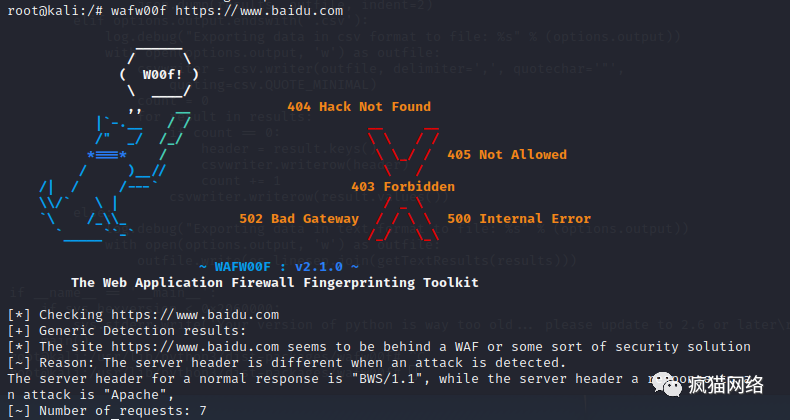
這里還可以用的服務器應該是BWS/1.1,但是它的響應包中返回的服務器是Apache,這里我們自己用burp抓包也能包:
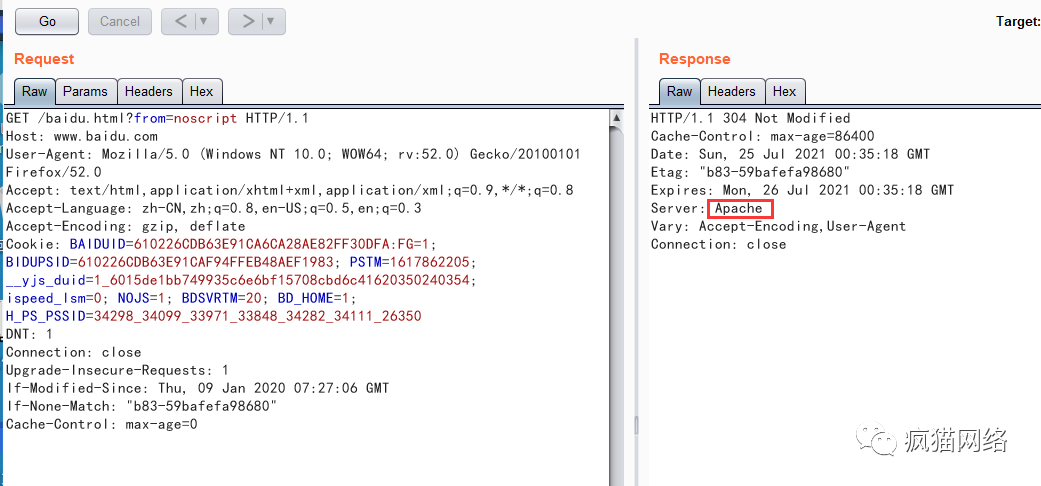
應該是修改了響應頭的返回。例如:進入org/apache/catalina/util編輯配置文件ServerInfo.properties字段來實現來改變我們tomcat的版本信息。
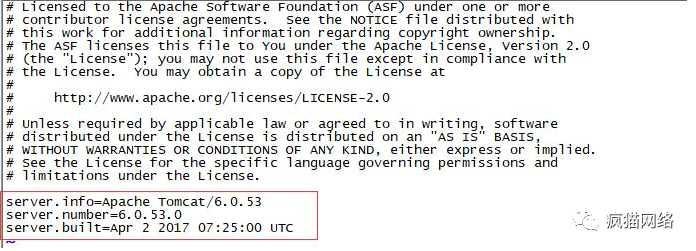
修改為:
  server.info=Apache Tomcat
server.number=0.0.0.0
server.built=Apr 2 2017 07:25:00 UTC
將修改后的信息壓縮回jar包:
  # cd  /tomcat/lib
# jar uvf catalina.jar org/apache/catalina/util/ServerInfo.properties
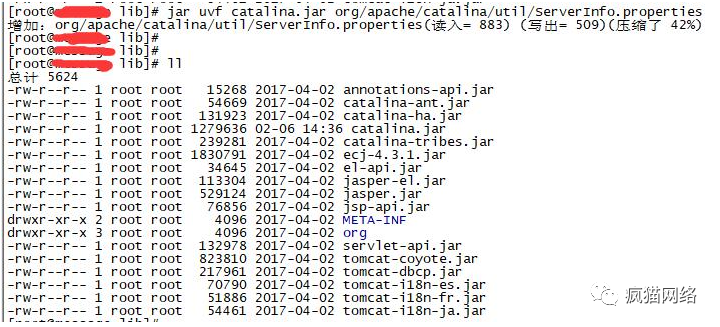
重啟公貓,驗證前后截圖如下所示: