【技術分享】借助DefCon Quals 2021的mooosl學習musl mallocng(源碼審計篇)
關于musl libc的資料比賽期間找到過一篇從一次 CTF 出題談 musl libc 堆漏洞利用,礙于musl libc在1.2.x之后的堆管理機制有較大的改版,因而有了該文章。本次文章分上下兩篇,從musl libc 1.2.2的源碼審計、調試,以及其中的利用機會,再到mooosl這道題的解題過程做一個分析。
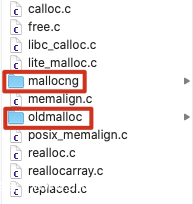
musl libc 1.2.2的源碼可以從[此處],(https://musl.libc.org/releases/musl-1.2.2.tar.gz)下載獲得。1.2.x采用src/malloc/mallocng內的代碼,其堆管理結構與早期版本幾乎完全不同,而早期的堆管理器則放入了src/malloc/oldmalloc中。
調試帶符號的musl libc
0x01源碼編譯
題目提供的libc.so不帶符號,很難通過調試去理解musl堆管理器的數據結構,可以通過源碼編譯,生成一份帶調試符號的libc.so,進行源碼級debug。
tar -xzvf ./musl-1.2.2.tar.gz
cd musl-1.2.2
mkdir build x64
cd build
CC="gcc" CXX="g++" \
    CFLAGS="-g -g3 -ggdb -gdwarf-4 -Og -Wno-error -fno-stack-protector" \
    CXXFLAGS="-g -g3 -ggdb -gdwarf-4 -Og -Wno-error -fno-stack-protector" \
    ../configure --prefix=/home/sung3r/workspace/sharefd/glibc/glibc-2.32/x64 --disable-werror
make
make install
在/src/x64/下找到編譯好的libc.so
通過patchelf將ld.so改成libc.so即可,gdb調試時加上dir /path/to/musl-1.2.2/src/malloc/和dir /path/to/musl-1.2.2/src/malloc/mallocng便可源碼調試。
0x02安裝調試符號
此方法要在ubuntu 20.04下才能成功
下載musl_1.2.2-1_amd64.deb、musl-dbgsym_1.2.2-1_amd64.ddeb
在ubuntu20.04安裝
sudo dpkg -i musl_1.2.2-1_amd64.deb
sudo dpkg -i musl-dbgsym_1.2.2-1_amd64.ddeb
gdb調試時通過dir加載源碼即可。推薦此方法,比較簡單,而且該deb里的libc.so與題目提供的libc.so md5一致。
源碼審計
meta.h
//line:124~127
static inline int get_slot_index(const unsigned char *p)
{
    //chunk地址往前的第3個byte就是該chunk的下標
    return p[-3] & 31;
}
//line:129~157
static inline struct meta *get_meta(const unsigned char *p)
{
    assert(!((uintptr_t)p & 15));//16字節對齊
    //獲取slot的偏移offset,offset*0x10才是真實偏移
    int offset = *(const uint16_t *)(p - 2);
    //獲取slot的下標,這里的slot就是我們習慣中理解的chunk
    int index = get_slot_index(p);
    if (p[-4]) {
        //如果offset不為0,表示不是group里的首個chunk,拋出異常
        assert(!offset);
        offset = *(uint32_t *)(p - 8);
        assert(offset > 0xffff);
    }
    //獲取group首地址,也即`meta->mem`這個地址
    const struct group *base = (const void *)(p - UNIT*offset - UNIT);
    //獲取meta地址,group首地址指向meta結構的地址
    const struct meta *meta = base->meta;
    assert(meta->mem == base);
    assert(index <= meta->last_idx);
    assert(!(meta->avail_mask & (1u<    assert(!(meta->freed_mask & (1u<    const struct meta_area *area = (void *)((uintptr_t)meta & -4096);
    //校驗Page的secret是否正確,防止偽造Page
    assert(area->check == ctx.secret);
    if (meta->sizeclass < 48) {//一般都為48個sizeclass
        assert(offset >= size_classes[meta->sizeclass]*index);
        assert(offset < size_classes[meta->sizeclass]*(index+1));
    } else {
        assert(meta->sizeclass == 63);
    }
    if (meta->maplen) {
        assert(offset <= meta->maplen*4096UL/UNIT - 1);
    }
    return (struct meta *)meta;
}
//line:229~238
//16字節對齊向上取整,最后換算成size_classes的下標,對group進行分類
static inline int size_to_class(size_t n)
{
    n = (n+IB-1)>>4;
    if (n<10) return n;
    n++;
    int i = (28-a_clz_32(n))*4 + 8;
    if (n>size_classes[i+1]) i+=2;
    if (n>size_classes[i]) i++;
    return i;
}
mallocng/malloc.c:
//line:174~284
static struct meta *alloc_group(int sc, size_t req)
{
...
    } else {///通過brk分配
        int j = size_to_class(UNIT+cnt*size-IB);
        int idx = alloc_slot(j, UNIT+cnt*size-IB);
        if (idx < 0) {
            free_meta(m);
            return 0;
        }
        struct meta *g = ctx.active[j];
        p = enframe(g, idx, UNIT*size_classes[j]-IB, ctx.mmap_counter);
        m->maplen = 0;
        p[-3] = (p[-3]&31) | (6<<5);
        for (int i=0; i<=cnt; i++)
            p[UNIT+i*size-4] = 0;///根據size清零mem
        active_idx = cnt-1;
    }
...
}
//line:300~381
//malloc的實現,lite_malloc調這里
void *malloc(size_t n)
{
    if (size_overflows(n)) return 0;
    struct meta *g;
    uint32_t mask, first;
    int sc;
    int idx;
    int ctr;
    //大于某一個閾值,通過mmap分配
    if (n >= MMAP_THRESHOLD) {///p MMAP_THRESHOLD; $10 = 0x1ffec
        size_t needed = n + IB + UNIT;
        void *p = mmap(0, needed, PROT_READ|PROT_WRITE,
            MAP_PRIVATE|MAP_ANON, -1, 0);
        if (p==MAP_FAILED) return 0;
        wrlock();
        step_seq();
        g = alloc_meta();
        if (!g) {
            unlock();
            munmap(p, needed);
            return 0;
        }
        g->mem = p;
        g->mem->meta = g;
        g->last_idx = 0;
        g->freeable = 1;
        g->sizeclass = 63;
        g->maplen = (needed+4095)/4096;
        g->avail_mask = g->freed_mask = 0;
        // use a global counter to cycle offset in
        // individually-mmapped allocations.
        ctx.mmap_counter++;
        idx = 0;
        goto success;
    }
    //否則通過brk分配
    //根據傳入size,轉換成size_classes的下標,根據sc申請相對應group的chunk
    sc = size_to_class(n);
    rdlock();
    //根據sc,獲取存放著對應size group的meta,如果還沒申請過這類group,對應ctx.active[sc]為0
    g = ctx.active[sc];
    // use coarse size classes initially when there are not yet
    // any groups of desired size. this allows counts of 2 or 3
    // to be allocated at first rather than having to start with
    // 7 or 5, the min counts for even size classes.
    if (!g && sc>=4 && sc<32 && sc!=6 && !(sc&1) && !ctx.usage_by_class[sc]) {
        size_t usage = ctx.usage_by_class[sc|1];
        // if a new group may be allocated, count it toward
        // usage in deciding if we can use coarse class.
        if (!ctx.active[sc|1] || (!ctx.active[sc|1]->avail_mask
            && !ctx.active[sc|1]->freed_mask))
            usage += 3;
        if (usage <= 12)
            sc |= 1;
        g = ctx.active[sc];
    }
    for (;;) {
        mask = g ? g->avail_mask : 0;
        first = mask&-mask;
        if (!first) break;
        if (RDLOCK_IS_EXCLUSIVE || !MT)
            g->avail_mask = mask-first;
        else if (a_cas(&g->avail_mask, mask, mask-first)!=mask)
            continue;
        idx = a_ctz_32(first);
        goto success;
    }
    upgradelock();
    //申請分配sc類別的chunk,size為n
    idx = alloc_slot(sc, n);
    if (idx < 0) {
        unlock();
        return 0;
    }
    g = ctx.active[sc];
success:
    ctr = ctx.mmap_counter;
    unlock();
    return enframe(g, idx, n, ctr);
}
//line:286~298
//申請chunk
static int alloc_slot(int sc, size_t req)
{
    uint32_t first = try_avail(&ctx.active[sc]);
    if (first) return a_ctz_32(first);
    //申請group,group信息存放于meta結構
    struct meta *g = alloc_group(sc, req);
    if (!g) return -1;
    g->avail_mask--;
    queue(&ctx.acti
    ve[sc], g);
    return 0;
}
free.c
//line:101~143
void free(void *p)
{
    if (!p) return;//地址為0,直接返回
    //獲取meta結構,以及做一些檢查
    struct meta *g = get_meta(p);
    //獲取chunk的下標
    int idx = get_slot_index(p);
    size_t stride = get_stride(g);
    unsigned char *start = g->mem->storage + stride*idx;
    unsigned char *end = start + stride - IB;
    get_nominal_size(p, end);
    uint32_t self = 1u<2u<last_idx)-1;
    //將對應chunk的下標置0xff
    ((unsigned char *)p)[-3] = 255;
    // invalidate offset to group header, and cycle offset of
    // used region within slot if current offset is zero.
    //將chunk的offset清0
    *(uint16_t *)((char *)p-2) = 0;
    // release any whole pages contained in the slot to be freed
    // unless it's a single-slot group that will be unmapped.
    if (((uintptr_t)(start-1) ^ (uintptr_t)end) >= 2*PGSZ && g->last_idx) {
        unsigned char *base = start + (-(uintptr_t)start & (PGSZ-1));
        size_t len = (end-base) & -PGSZ;
        if (len) madvise(base, len, MADV_FREE);
    }
    // atomic free without locking if this is neither first or last slot
    //設置meta的avail_mask`freed_mask
    for (;;) {
        uint32_t freed = g->freed_mask;
        uint32_t avail = g->avail_mask;
        uint32_t mask = freed | avail;
        assert(!(mask&self));
        if (!freed || mask+self==all) break;
        if (!MT)
            g->freed_mask = freed+self;
        else if (a_cas(&g->freed_mask, freed, freed+self)!=freed)
            continue;
        return;
    }
    wrlock();
    struct mapinfo mi = nontrivial_free(g, idx);
    unlock();
    if (mi.len) munmap(mi.base, mi.len);
}
meta、group、chunk的具體結構,以下通過debug進行分析。
分配釋放
store('a0a0', 'b0b0')
store('a1a11', 'b1b1111')
delete('a0a0')
__malloc_context是musl libc的全局管理結構指針,存放在libc.so的bss段
gef?  p __malloc_context
$1 = {
  secret = 0x69448097523526a7,
  init_done = 0x1,
  mmap_counter = 0x0,
  free_meta_head = 0x0,
  avail_meta = 0x56042ee901f8,
  avail_meta_count = 0x59,
  avail_meta_area_count = 0x0,
  meta_alloc_shift = 0x0,
  meta_area_head = 0x56042ee90000,
  meta_area_tail = 0x56042ee90000,
  avail_meta_areas = 0x56042ee91000 ,
  active = {0x56042ee901d0, 0x0, 0x0, 0x56042ee901a8, 0x0, 0x0, 0x0, 0x56042ee900b8, 0x0, 0x0, 0x0, 0x56042ee90090, 0x0, 0x0, 0x0, 0x56042ee90068, 0x0, 0x0, 0x0, 0x56042ee90040, 0x0, 0x0, 0x0, 0x56042ee90018, 0x0 times>},
  usage_by_class = {0x1e, 0x0, 0x0, 0x7, 0x0 times>},
  unmap_seq = '\000' times>,
  bounces = '\000' times>,
  seq = 0x0,
  brk = 0x56042ee91000
}
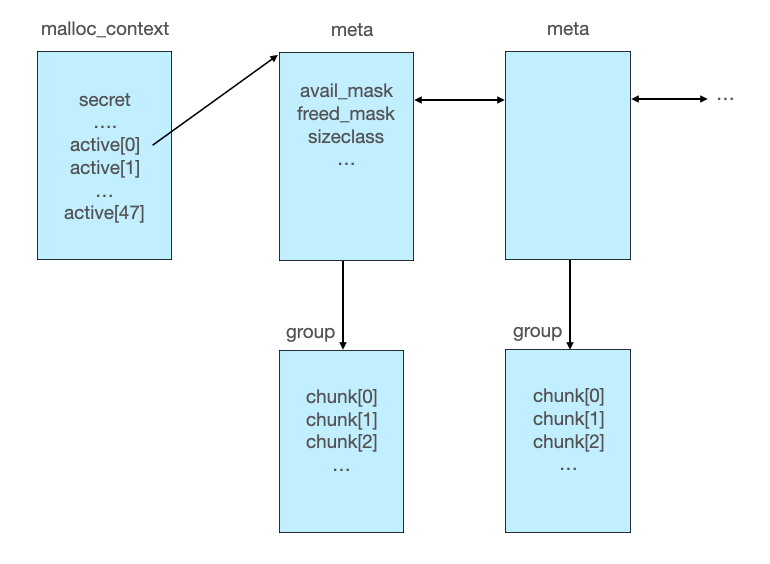
active = {0x56042ee901d0,0,0...:堆管理器依據申請的size,將chunk分成48類chunk,由sizeclass指定。每類chunk由一個meta結構管理,meta管理的chunk個數有限,由small_cnt_tab指定。當申請個數超出一個meta所能管理的最大數量,堆管理器會再申請同類型meta管理更多的chunk,并且以雙向鏈表結構管理這些相同類型的meta。
usage_by_class = {0x1e, 0x0, 0x0, 0x7,...:表示當前各meta管理著的chunk個數。
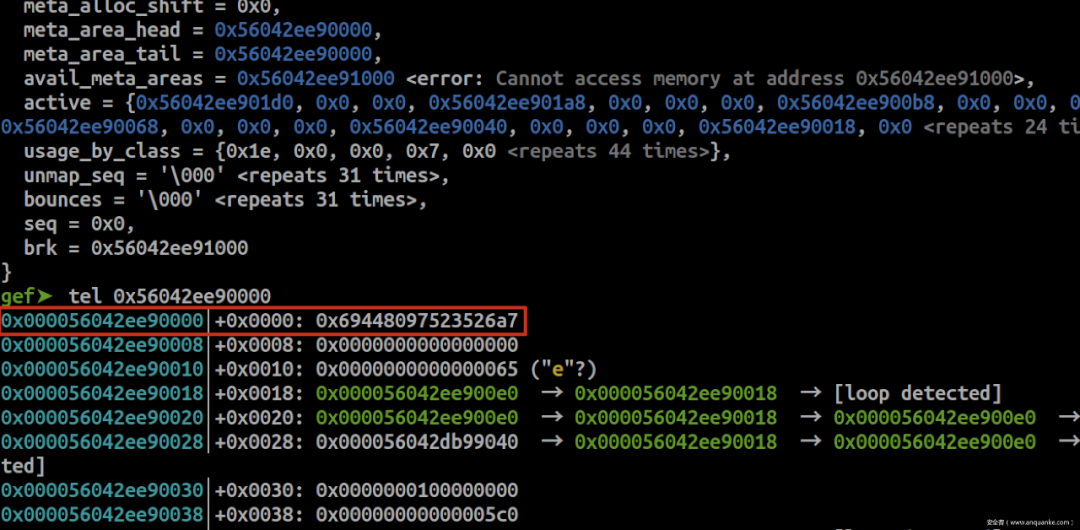
secret = 0x69448097523526a7:在meta域每個page大小的首8個byte,都會存在一個校驗key。
musl libc用以下的結構管理著meta、group以及chunk
分配了兩個0x30的chunk,未釋放。
gef?  p *(struct meta*)0x56042ee901a8
$2 = {
  prev = 0x56042ee901a8,
  next = 0x56042ee901a8,
  mem = 0x7f79e1df5c50,
  avail_mask = 0x7c,
  freed_mask = 0x0,
  last_idx = 0x6,
  freeable = 0x1,
  sizeclass = 0x3,
  maplen = 0x0
}
prev和next都指向本身,表示只有一個meta頁,meta頁由一個雙向鏈表進行維護;
0x7f79e1df5c50是user data域;
avail_mask = 0x7c = 0b1111100表示第0、1個chunk不可用(已經被使用);
freed_mask = 0x0表示沒有chunk被釋放;
last_idx = 0x6表示最后一個chunk的下標是0x6,總數是0x7個
sizeclass = 0x3表示由0x3這個group進行管理。
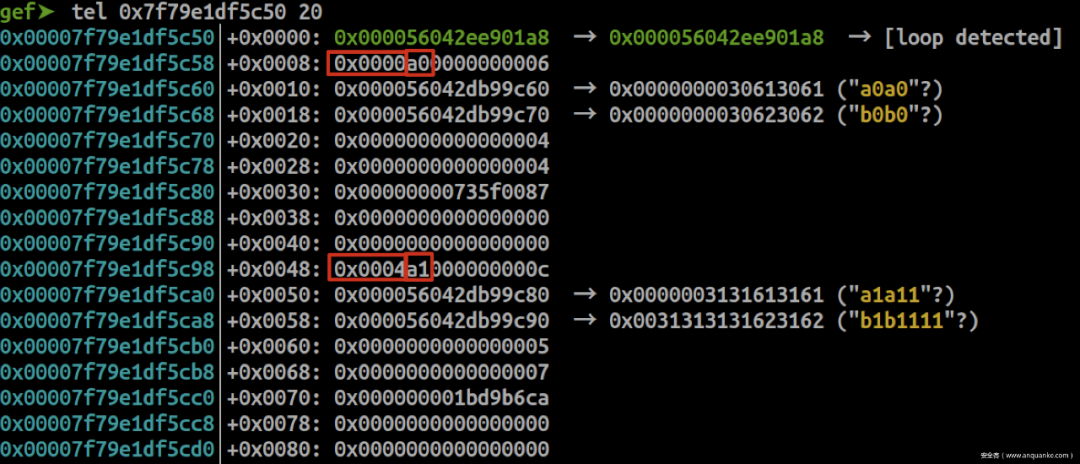
0x000056042ee901a8指向meta結構的地址;
后面8個byte表示chunk的頭部結構:
0x0000和0x0001表示當前chunk,距離group首地址0x00007f79e1df5c58的偏移為0和0x40;
0xa0和0xa1表示當前chunk是group中的第0和1個chunk;
再往后0x28個byte就是user data域,最多接收輸入0x28+4個byte,占用下一個chunk的前4個byte。
同時,也分配了四個0x10的chunk,未釋放
gef?  p *(struct meta*)0x56042ee901d0
$3 = {
  prev = 0x56042ee901d0,
  next = 0x56042ee901d0,
  mem = 0x56042db99c50,
  avail_mask = 0x3ffffff0,
  freed_mask = 0x0,
  last_idx = 0x1d,
  freeable = 0x1,
  sizeclass = 0x0,
  maplen = 0x0
}
prev和next都指向本身,表示只有一個meta頁,meta頁由一個雙向鏈表進行維護;
0x56042db99c50是user data域;
avail_mask = 0x3ffffff0 = 0b111111111111111111111111110000表示第0、1、2、3個chunk不可用(已經被使用);
freed_mask = 0x0表示沒有chunk被釋放;
last_idx = 0x1d表示最后一個chunk的下標是0x1d,總數是0x1e個
sizeclass = 0x3表示由0x3這個group進行管理。
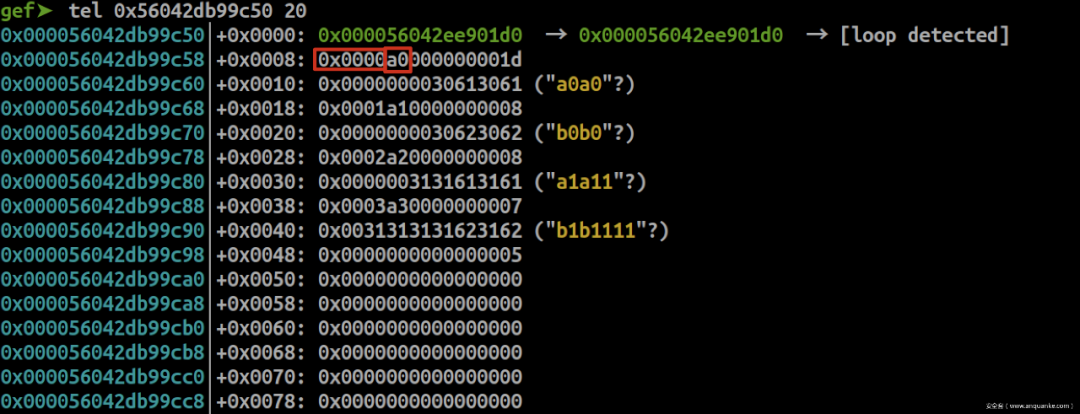
0x0000、0x0001、0x0002、0x0003表示距離group首地址偏移為0、0x10、0x20、0x30byte;
0xa0、0xa1、0xa2、0xa3表示group中的chunk下標;
往后8byte是user data,user data最多接收輸入8+4個byte,占用下一個chunk header的前4個byte(與x86的glibc類似)
釋放兩個0x10的chunk
gef?  p *(struct meta*)0x56042ee901d0
$9 = {
  prev = 0x56042ee901d0,
  next = 0x56042ee901d0,
  mem = 0x56042db99c50,
  avail_mask = 0x3fffffe0,
  freed_mask = 0x3,
  last_idx = 0x1d,
  freeable = 0x1,
  sizeclass = 0x0,
  maplen = 0x0
}
freed_mask = 0x3 = 0b11表示前兩個chunk被釋放;
avail_mask = 0x3fffffe0 = 0b111111111111111111111111100000可以發現,此時前兩個chunk仍然為不可分配的狀態;
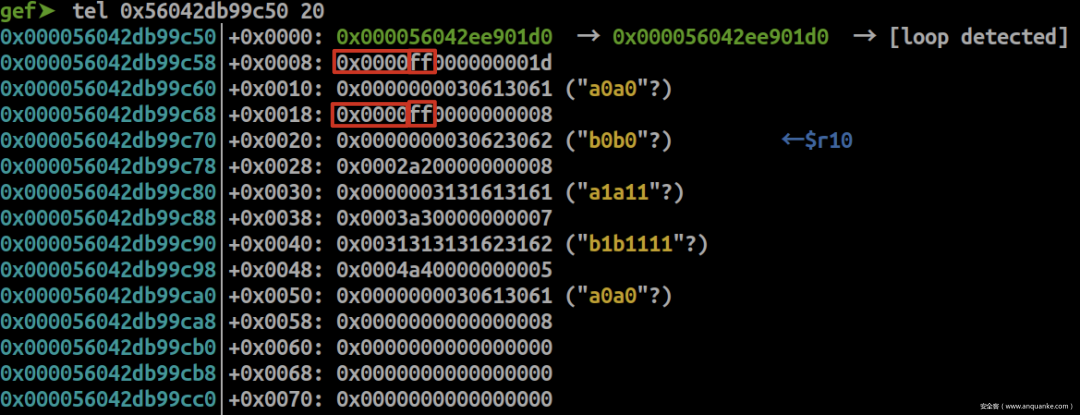
已釋放的chunk會將chunk header的offset清零,并且將chunk下標置成0xff,不清空user data域。
釋放一個0x30的chunk
gef?  p *(struct meta*)0x56042ee901a8
$13 = {
  prev = 0x56042ee901a8,
  next = 0x56042ee901a8,
  mem = 0x7f79e1df5c50,
  avail_mask = 0x7c,
  freed_mask = 0x1,
  last_idx = 0x6,
  freeable = 0x1,
  sizeclass = 0x3,
  maplen = 0x0
}
freed_mask = 0x1表示有1個已被釋放的chunk。
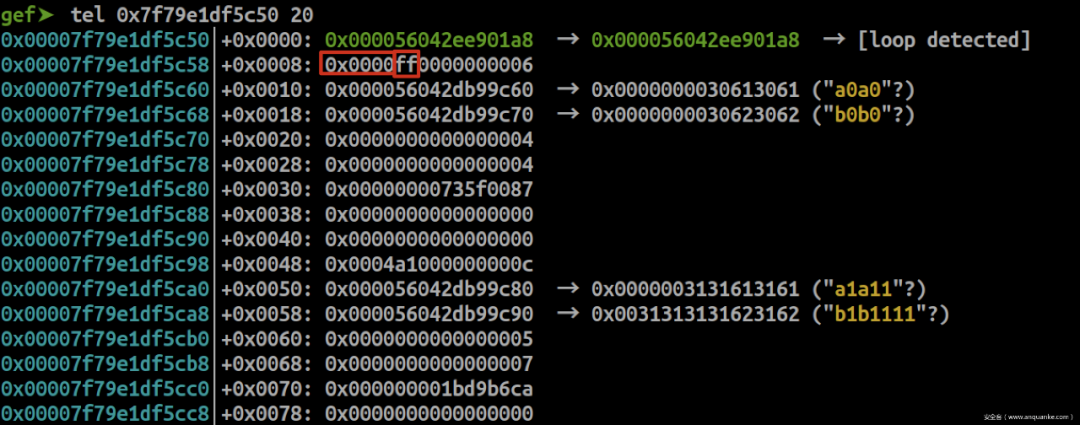
同樣,chunk header的offset清零,且chunk下標置0xff。
const uint16_t size_classes[] = {
    1, 2, 3, 4, 5, 6, 7, 8,
    9, 10, 12, 15,
    18, 20, 25, 31,
    36, 42, 50, 63,
    72, 84, 102, 127,
    146, 170, 204, 255,
    292, 340, 409, 511,
    584, 682, 818, 1023,
    1169, 1364, 1637, 2047,
    2340, 2730, 3276, 4095,
    4680, 5460, 6552, 8191,
};
static const uint8_t small_cnt_tab[][3] = {
    { 30, 30, 30 },
    { 31, 15, 15 },
    { 20, 10, 10 },
    { 31, 15, 7 },
    { 25, 12, 6 },
    { 21, 10, 5 },
    { 18, 8, 4 },
    { 31, 15, 7 },
    { 28, 14, 6 },
};
static struct meta *alloc_group(int sc, size_t req)
{
    size_t size = UNIT*size_classes[sc];
    int i = 0, cnt;
    unsigned char *p;
    struct meta *m = alloc_meta();///分配內存,用于建立一個group
    if (!m) return 0;
    size_t usage = ctx.usage_by_class[sc];
    size_t pagesize = PGSZ;
    int active_idx;
    if (sc < 9) {
        while (i<2 && 4*small_cnt_tab[sc][i] > usage)
            i++;
        cnt = small_cnt_tab[sc][i];
    } else {
...
    ctx.usage_by_class[sc] += cnt;
...
幾個有用的結構
group分類表,由sc指定由哪個group管理:usage_by_class = {0,0,0,…}
要申請的chunk大小,由這個大小計算出sc:req = 0x30 -> sc = 0x3
malloc的chunk大小:UNITsize_classes = 0x10 0x3 = 0x30
設定該group最多有多少個chunk:ctx.usage_by_class[sc] = 30 = 0x1e
漏洞點(Info Leak)
0x30 chunk, malloc 6次,free 5次
store('A', 'A')
for _ in range(5):
    query('A' * 0x30)
avail_mask = 0x40 = 0b1000000除了最后一個chunk,其余chunk不可分配;
freed_mask = 0x3e = 0b111110除第一個以及最后一個chunk,其余chunk已被釋放
gef?  p *(struct meta*)0x55b9b0b551a8
$2 = {
  prev = 0x55b9b0b551a8,
  next = 0x55b9b0b551a8,
  mem = 0x7fccf5fdcc50,
  avail_mask = 0x40,
  freed_mask = 0x3e,
  last_idx = 0x6,
  freeable = 0x1,
  sizeclass = 0x3,
  maplen = 0x0
}
可以發現,free掉的chunk不會優先分配
chunk在被free后不會清空user data域
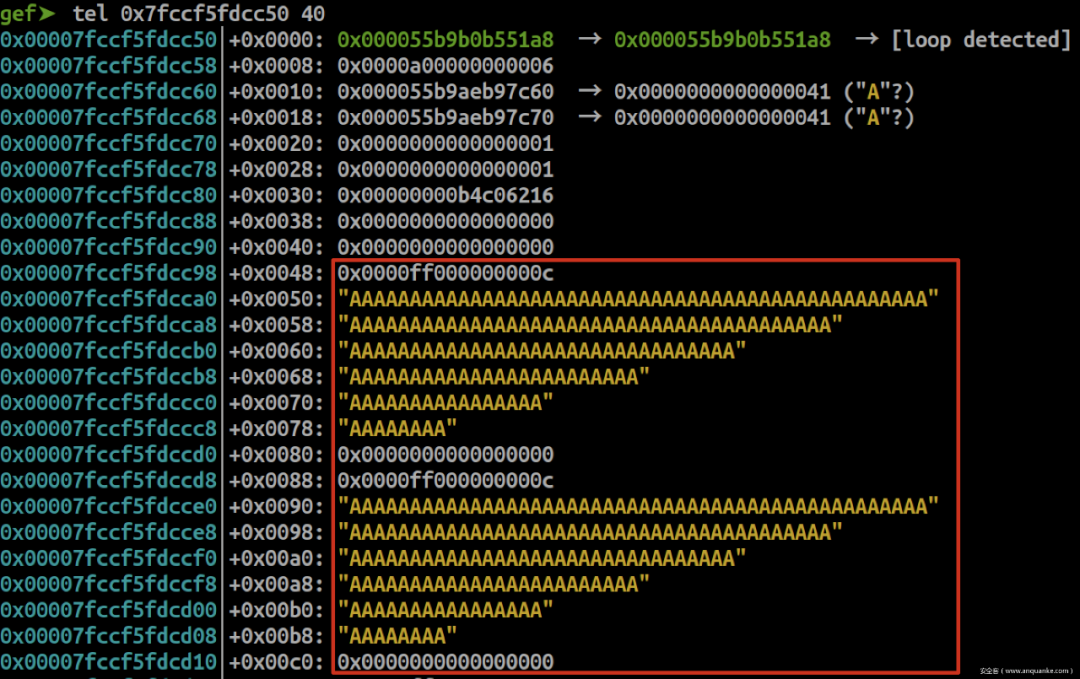
增加到malloc 8次,free 7次
store('A', 'A')
for _ in range(5):
    query('A' * 0x30)
query('A' * 0x30)
query('B' * 0x30)
avail_mask = 0x7c = 0b1111100被釋放的chunk重新分配,也就是當耗盡該group的7個chunk時,堆管理器才會檢查是否有已被free掉的chunk,將這些chunk的avail_mask置1,再重新分配。
gef?  p *(struct meta*)0x5575a83401a8
$2 = {
  prev = 0x5575a83401a8,
  next = 0x5575a83401a8,
  mem = 0x7f54fbdeec50,
  avail_mask = 0x7c,
  freed_mask = 0x2,
  last_idx = 0x6,
  freeable = 0x1,
  sizeclass = 0x3,
  maplen = 0x0
}
現在可以分配回先前已被釋放的chunk,這樣就有了uaf的利用機會。通過重新將帶指針的結構體chunk分配回來,可leak出內存信息。
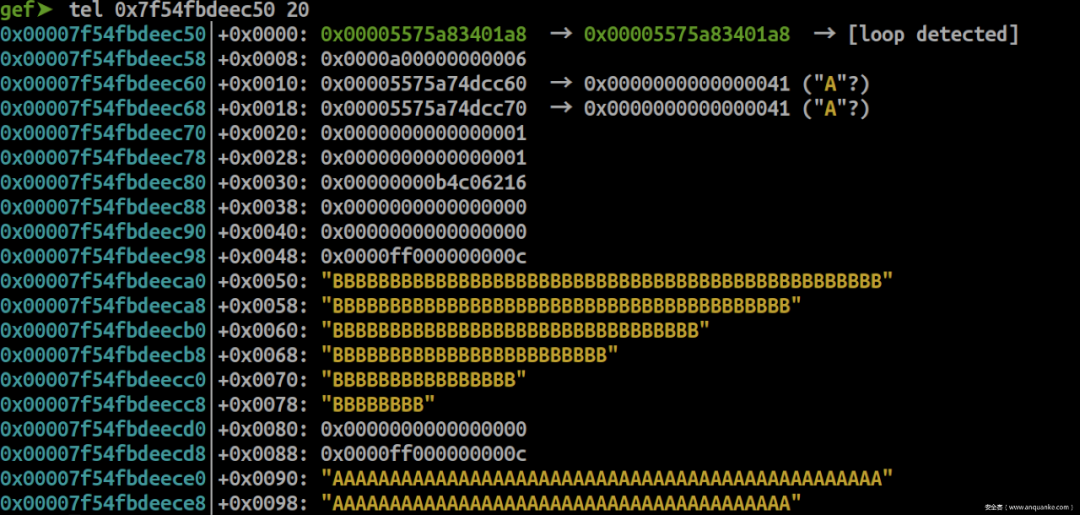
漏洞點(Hijack)
meta.h
//line:90~100
static inline void dequeue(struct meta **phead, struct meta *m)
{
    if (m->next != m) {
        m->prev->next = m->next;
        m->next->prev = m->prev;
        if (*phead == m) *phead = m->next;
    } else {
        *phead = 0;
    }
    m->prev = m->next = 0;
}
在審計源碼時,可以發現這個經典的unsafe-unlink漏洞,跟早期glibc版本unlink宏出現的問題十分類似。
通過偽造fake meta,在刪除該meta時,便會產生一次任意寫,那么就有了劫持的機會。關于mooosl這道題的完整利用過程會在下篇文章中分析。